Tuesday, November 4, 2025

Caught Stealing


Director: Darren Aronofsky

Starring: Austin Butler, Zoe Kravitz, Regina King, Matt Smith

I told my wife Steph we were going to sit down and watch a thrilling, sexy crime mystery of a movie when I offered up ‘Caught Stealing’ on a random weekday night. Boy, was I mistaken. I should’ve known. This is Darren Aronofsky we are talking about. The man who directed Black Swan, a borderline horror movie. And Requiem for a Dream, which I absolutely qualify as a horror movie based on the nightmares Jared Leto gave me as a kid. But sometimes marketing works REALLY well. And in this case the trailer was one of action as opposed to melancholy. The lesson here is to never underestimate Aronofsky’s melancholy. 

No spoilers of course, but this man knows how to tug at your heart strings with a bleak, and I mean bleak, view of humanity. The premise is pretty straightforward – a former ball player gets asked to watch his neighbor’s cat for a weekend, and then all hell breaks loose. He finds himself wrapped up in a potential drug deal gone bad with all the wrong people you never want to be associated with. I loved the setting: gritty NYC vibes, it felt like I was watching ‘The Professional’ on the Upper East Side all over again. Capturing everyday New York life between bodegas, bars, and apartment buildings was perfect. Never a dull moment apart from Austin Butler’s quiet introspection as a failed professional athlete. We can only guess what’s going through his head most of the time but you also kind of already know. I knew a guy in college who blew out his arm after signing a $90,000 signing bonus with a pro team. He spent seventy-five of it on a truck. Tough break. He worked construction after that. 

That deep loss of identity is present here with Butler’s character, but the action of the film takes a left hand turn early and puts you right on your ass. It goes from character study to John Wick pretty quick. I loved it. My wife was less enthused based on how I had sold it into her (understandably). But this is actually where I think the movie turns for the better.

 Butler’s character is forced to reckon with his identity in a way that shows how his actions have an impact on other people more than himself. It’s easy to wallow in your failures. It’s simple to factor in all the external forces that led to your lack of success and blame them ad nauseam. What is hard is owning it. Taking accountability for how you contributed to your own failures and the consequences that affect everyone in your life. Seeing how your nature shows up in your shortcomings. I think we are all wired to blame outside forces as a defense mechanism. And it usually takes watching someone else wear our black eye before we realize how we’ve fallen short. Only for most of us, our path to redemption reveals itself more in spiritual form and less in a revenge-fueled robbery shootout. 

The redemption arc in Caught Stealing is not straightforward. There’s a lot of zigging and zagging and twists and turns that leave you guessing about who is responsible for what. I love that level of discombobulation as a viewer, but it may not be for everyone. I could hear my parents saying, “who are those guys?” every time a threat was reintroduced. In that way it absolutely succeeds as a great thriller: keeps you on your toes, keeps you guessing, keeps you dissatisfied until the end. 

My recommendation? Watch it with an open mind. Put yourself in Austin Butler’s shoes. Consider how we contribute to our own failure, and what that actually means for finding the light. 


Monday, March 6, 2017

Manchester by the Sea


Down and Dirty: Saddest movie I’ve ever seen. Incredibly good film.
Director: Kenneth Lonergan
Big Names: Casey Affleck, Michelle Williams, Kyle Chandler
You may have heard about this movie. I heard it was a good film but a very sad one. That’s an apt description but it also wildly undersells the depth of the story. This is a character study in pain. Not in a grotesque or artificial way. It is a mirror. It is a nuanced reminder that through an unfortunate cocktail of character flaws and circumstances we are all capable of being the villain in our own tragedy.  
As you may know, Casey Affleck recently won the Academy Award for Best Actor in a Motion Picture for his performance in Manchester by the Sea. The award was completely deserved for his performance in this film, though recent allegations of sexual harassment have cast a dark shadow on his Oscar statue. There are other articles that deal with this issue more deftly than I ever could, but I will say that the issue cannot be ignored and I was deeply disappointed to read that a man of his standing would consider leveraging his position in the industry to mistreat women in any way. While his faults as a man undoubtedly distract from his talent as an actor, his role in this film was something to behold.
There is no better example of his transcendent performance than in a scene that effectively acts as the emotional climax, filling many of the narrative gaps that exist up to that point. It is one of the most moving, depressing, emotionally raw scenes I have ever watched. Two hours after the movie was over I could not shake it from my mind and I reflected very deeply on the emotions it stirred within me. It is odd how I began to empathize with Casey Affleck’s despair having never been a similar position. But I felt it nonetheless. His pain was mine and I could feel the weight of grief.
If you’ve ever been shocked by the news of someone’s death, you know this feeling. But it’s not as simple as death and the associated pain. It is the dissolution of something beautiful. Broken into a thousand pieces, shattered and stolen. It is tragedy.
Then come regret, shame, and self-loathing. Director Kenneth Lonergan has perfected the art of extracting these feelings from his characters and pouring them out into your soul. I cannot describe how exactly he does it but the music, cinematography, and acting blend together in a beautifully sad way that will stir your heart.
Viewers may be upset by the defeatist nature of such tragedies. But isn’t that real life? Aren’t we in fear that there is no grace for the most broken parts of ourselves? The question is asked but remains, in some ways, unanswered in Manchester by the Sea. There is an allusion to the redemption one might find with God, but it is not explored in any great depth. I wish it had been. In my relatively young life, I have found that such redemption exists in God alone. Despite all of our strength, when left to our own devices we become seized by the idea that we deserve to pay the price for our misdeeds and we sink under the weight of it. Manchester by the Sea illustrates this notion in the most unadulterated way imaginable. Casey Affleck is your pain surrogate. Feel what he feels and reflect on the weight of his tragedy. Ask yourself if there is grace enough for him. Ask yourself if there is grace enough for you.

Wednesday, November 11, 2015

The Spy movie you should see VS. The Spy movie you will see


vs. 


We are on the brink of a major motion picture extravaganza. In just a little over a week from now the final installment of the Hunger Games franchise will be released followed shortly thereafter by the first Star Wars film in over a decade. I’m not here to talk about any of that yet. We have a short window of dead space between now and then where you may find yourself at the movie theater deciding what to watch. I’m here to help you make that decision.

Chances are you will end up seeing a spy movie. I know that because there are only two new films at the box office worth seeing (not counting Matt Damon in Space) and they both revolve around espionage. You’ve probably heard that James Bond is back in his newest film ‘Spectre.’ You may not have heard that Tom Hanks is running around lawyering the hell out of the Soviets in the film ‘Bridge of Spies.’ Speaking as a millennial, I believe that younger people will gravitate towards the former and not the latter. Huge mistake! “Big deal” you might say. “Sounds relatively inconsequential” you might say. “Still enjoyed the Bond film” you might say even after you realize YOU BLEW IT once you finish this post. Wrong-o. Indulge me.

Generation Y people have grown up with total national security. I would argue that September 11th even deepened our belief that this nation will be made safer at all costs. We truly have never feared being attacked by another global power. We can’t even comprehend what that type of fear feels or looks like. Generation X lived during the Cold War. They learned to fear the danger of nuclear war and tried to grasp the threat of another global superpower, Soviet Russia, usurping the United States. Communism was an ideology that swept over Eastern Europe and changed the entire international climate for better and, often times, for worse. Speaking for Gen Y, as people who weren’t alive during that time how can we possibly understand what that was like? The answer is film! Specifically a new film titled ‘Bridge of Spies’ starring Tom Hanks. Because this blog is titled ‘No Spoilers’ I’m not going to dig into the plot here. I just want to appeal to the reader to consider seeing an incredibly intriguing, slower film that is sure to broaden your horizons as opposed to an entertaining, cookie-cutter, action film (Spectre) that is sure to make you appreciate Daniel Craig’s fashion sense. The story telling in ‘Bridge of Spies’ is top notch and it will not only give you some understanding of a past generation, but it will help you empathize with the dangerous international climate that still exists in other countries today. The situations in Syria, Iraq, and the heightened Israel/Palestine conflict all feel more ‘real’ after seeing this film. People abroad are still living in this state of fear and imminent threat. We shouldn’t do our best to avoid understanding real conflict, historical or current, because it seems like a slower story.


Don’t get me wrong, James Bond is fun. But going to see a film can be used as an opportunity to change the way you think about real life. Movies as a medium can be incredibly educational and eye-opening, though we must take special care to acknowledge inherent bias. ‘Bridge of Spies’ is an American movie opening in America so you can expect the Soviet Russians to be demonized a bit. Regardless, the film will have you thinking about international diplomatic relations in a way you probably haven’t thought about before. This is in large part a result of some truly great & honest acting from the entire cast - most notably Tom Hanks. If you find yourself at the theater I implore you to take the opportunity to absorb a worthwhile message. But hey, James Bond is guaranteed to blow shit up by shooting a gas tank so whatever floats your boat. 


Wednesday, May 6, 2015

Avengers: Age of Ultron


Down & dirty: The second superhero reunion is a hollow joyride - fun and disposable.
Director: Joss Whedon
Big Names: Seriously everyone...RDJ, Chris Evans, Mark Ruffalo, Chris Hemsworth, ScarJo, Jeremy Renner, James Spader, Samuel L. Jackson, Don Cheadle, the cast of Pitch Perfect, my dog, Obama, just everyone ever.


Do you remember eating Dunkaroos back when you were a kid? I recognize this reference panders to 90’s babies but bear with me. Dunkaroos were great. Endearing kangaroo mascot, chocolate cookies with a little bucket of vanilla frosting you could dip them in! What’s better than that? The problem was that there were about four tiny cookies per pack. It just wasn't satisfying…even as an 8 year old. Eventually people caught on and realized they were an overpriced, unfulfilling sugar bomb.

That’s Avengers: Age of Ultron. Four chocolate cookies with delicious vanilla frosting and a feeling of ‘but I wanted more!’ upon its completion. Every single person I've spoken to has said they enjoyed this film. I get it. There is a lot of action, funny moments, recognizable superheroes. It is enjoyable. But it could have been so much more.

Maybe I’m being pretentious – I accept that is entirely possible. But when I say more I don’t mean more explosions, more robots, or more infinity stones (certainly not more infinity stones). I mean more depth. This film has already made more money than the GDP of a small nation so I’m not questioning it’s marketability or its basic entertainment value. I’m talking about humanizing the film: moral code and familial obligation. Let’s take those one at a time.

Morally the film tries to tackle the idea of artificial intelligence and the problems it creates when we get too close to creating life. I guess I was hoping for more ‘Ex Machina’ and less ‘iRobot’. More nuanced arguments and less total destruction. It felt like ground that had been tread on so many times before that I already knew exactly how it would end. I won’t spoil it for you but I’d bet my salary that you could guess how the final battle unfolds (See: The Avengers). What if the filmmakers had utilized this massive platform of film distribution to seriously ask a meaningful question like ‘is an intelligent and unemotional machine better suited than us to be judge & jury?’ instead of just showcase said machine as a furiously blind executioner.

In terms of familial obligation I appreciate the effort the filmmakers put into trying to humanize Hawkeye. Guess what? That still fell flat. I’ll give you a tease of a spoiler here: you are introduced to Hawkeye’s family. Implemented as an interesting aside to the major story line, it is completely disposed of when the plot device has served its initial purpose as if to say “Look! Real life! We included it! – Now let’s get back to laying waste to everything.” Again, I’m not asking a superhero movie to be a Shakespearean exploration of human interaction but come on - if you’re going to include real family dynamics at least make it honest.   

Those are my gripes. I accept the title of 'only person who didn't love it'. Again, it was still incredibly well made. It’s worth watching. I just thought they missed an absolutely monstrous opportunity to say something meaningful. I enjoyed the film and I enjoyed Dunkaroos…while they lasted.

Tuesday, January 20, 2015

Boyhood

Down & Dirty: Epic coming of age drama, worth the time investment
Director: Richard Linklater
Big Names: Ethan Hawke, Patricia Arquette


SO PROUD to announce my first guest review........courtesy of my Mom!!!

Take it away Suze...

BOYHOOD is an epic drama tracing the life of a boy and his family as he grows up from age 6 to age 18. The film takes viewers seamlessly through the years with scenes from young Mason’s life, evoking nostalgia, warmth, and sadness. Strong characters Mom, Dad, and Mason develop incrementally along the way—flawed, yet genuine and sympathetic. Viewers will identify with different characters in particular scenes. In one especially poignant moment, Mom (played by Patricia Arquette) breaks down as Mason is about to leave for college, crying out “You are so happy!” capturing the gulf between the rocky emotions of the soon to be empty-nest parent and the eager-to-leave home adolescent.

                It is impossible to watch this movie without looking forward, backward and inward at one’s own life. The film, through character studies, explores the themes of human resiliency and redemption, questioning “what’s the point?” from the perspectives of Mom, Dad, and son. Without directly answering the question, later scenes allude to a spiritual aspect in the father’s life revealing how he has matured emotionally, vocationally, and spiritually. The film compels the viewer’s respect for Mom’s survival instinct and tenaciousness. Meanwhile, Mason’s teenage sloth behavior morphs into philosophical exploration; later into more mature reflection and signs of an emerging work ethic.  All three main characters explore the question of timing in relationships with the benefit of doing a “fly over” of their lives over the last dozen years.


                As a person who is very picky about watching 3-hour movies, I am glad I did not know the length before watching the film. It was well worth the time.

-Suzanne Keating 

Thursday, January 15, 2015

The Best Film of 2014


The Imitation Game

Down & Dirty: The best film of 2014

Director: Morten Tyldum

Big Names: Benedict Cumberbatch, Keira Knightley

Occasionally a film will come around that does a little bit of everything perfectly. Solid amount of drama. Tiny dose of comedy. Good bit of intrigue. Snippets of romance. These elements are interwoven seamlessly to create a flush montage – a well told story. Of course none of this is possible without a good premise. And where do the best premises come from? True stories. Drama rooted in reality.
The Imitation Game does what Unbroken could not do. It takes a true story and makes it so powerful, so urgent and personal that it commands your full emotional attention. Angelina Jolie’s film focused on human triumph in the face of unfathomable adversity. But in that movie the viewer only knows Louie in the context of several mostly horrific situations. It doesn’t feel real until you walk out of the theater and remind yourself, “Wow that legitimately did happen.” The Imitation Game suffers no such delayed empathy. This is the tale of Alan Turing, an Einstein-like genius who accelerated World War II about five years in the Allies favor. How? He cracked the unbreakable Nazi communication code known as Enigma using the earliest computer engineering. To tell you the machinations through which he did it and the opposition he faced throughout the process would be to rob you of a most fulfilling cinematic experience. But I will give a shameless sales pitch on why it is worth watching.
The penmanship of the script can and should be appreciated by all. A World War II political thriller revolving around the life of a mathematician is such a mundane premise to history-handicapped millenials, but the dialogue is sharp enough to stay relevant. Cumberbatch’s Sherlock-like demeanor captivates the viewer right off the bat. Don’t know about WWII? Don’t sweat it. The film does a phenomenal job of informing the viewer without condescending, unlike the character of Alan Turing.
Turing can truly be a prick. His abrasive nature is seemingly the social deficiency manifested in his genius. I’ve never seen an actor so completely embrace this stigma of genius. Cumberbatch is believable in every moment of bewilderment at his own unpleasantness. The ticks, the arrogant looks, and the obsessive behavior - it’s all beautifully portrayed in Cumberbatch’s committed performance. The Oscar nomination for Best Actor is fully deserved. As is the film’s overall nomination for Best Picture.
(SPOILER AHEAD)
I will spoil one bit for you because it deserves talking about: Alan Turing was gay. You might be asking yourself why you haven’t heard of Alan Turing before. The answer is shocking, unfortunate, and straight-forward.
England buried him. Both figuratively and literally.
His country failed to recognize him for his accomplishments (War-time and otherwise) until one year ago due to the fact that they persecuted him for his sexuality back in the 1950’s. He was forced to undergo hormonal treatment which eventually drove him to suicide. Take that in. It took until one year ago to recognize this man’s accomplishments because he was attracted to the same sex. Just remember that we as a society have the capacity for extraordinarily inhumane treatment and we often still refuse to own up to those mistakes in retrospect. Forgiveness is consigned to oblivion.
During the Oscar campaign, the film’s promoters really pushed the angle of The Imitation Game being a platform for the rights of homosexuals and the historical persecution homosexuals have faced. Rightfully so – but it would be a shame to pigeon hole this film as a socio-political rallying point.  It’s so much more than that. The entire filmmaking process blends together to create an unforgettable cinematic experience. Movies like The Imitation Game only come around once in a while. Don’t miss it.

Tuesday, December 9, 2014

Mockingjay Part 1


Down and Dirty: Is it a set-up for the finale? Yes. Is it a worthy addition to the franchise? Absolutely.

Director: Francis Lawrence

Big Names: Jennifer Lawrence, Josh Hutcherson, Liam Hemsworth, Woody Harrelson, Philip Seymour Hoffman (RIP)


Why all the hate? Especially during the holidays.

A large portion of the critical reviews I’ve seen about the latest Hunger Games installment refer to it as a ‘filibuster’ or ‘monetary filler’ for the eventual finale due out November 2015. This of course suggests that Mockingjay Part 1 does not have the legs to carry an enthralling story arc – and while it has more drawn out instances of exposition than the previous movies, this film stands on its own quite well.

Francis Lawrence returns to direct his second film of the franchise after his wildly successful adaptation of Catching Fire. A wise decision. The continuity felt from the get go of Mockingjay Part 1 allows the viewer to slip right back into the environment, story, and emotion that define the hallmark of this generation’s dystopian storytelling. That uninterrupted flow is the single ingredient that awakens the viewer’s nostalgia after a yearlong hiatus from Katniss’ butt-kicking sass. It is the seamless transition from friendly banter to politico debate one can always count on at Thanksgiving dinner – you know Aunt Carrie will bring the liberal hammer down, it’s a welcome expectation. 

That’s what this movie did. It provided the smelling salts to reinvigorate our love for revolution and then it set out the mouthwatering sample for what is to come. But that’s all it really needed to do. There’s no reason to knock this film for executing plot set up in a meaningful way. This iteration of Hunger Games was going to carry the weight of the story no matter how the producers chose to slice it. By breaking Mockingjay into two films they have allowed for vast swaths of space to develop characters that will undoubtedly make or break the authenticity of the final movie. Francis Lawrence definitely makes the most of this opportunity.
He develops Katniss’ pain like a sculptor. You get the breadth of her sorrow in one fell swoop and then it is refined throughout the film. Her agony is at first widespread, covering a multitude of issues - the struggle of being the reluctant leader, the losses she experiences both at home and abroad, and the brutal pain of love, unrequited and reciprocated alike. But it eventually narrows, targeting Katniss’ deepest cuts (see: Peeta). The director utilizes his Oscar-winning actress to illustrate the raw emotion and J-Law yet again delivers as this tumultuous but driven version of Katniss Everdeen. Jennifer Lawrence embraces the shift and embodies a woman of conviction. It is terrific acting and there are even a few nods to her off-screen personality that make the performance feel truly authentic. The viewer knows J-Law and it serves to make Katniss even more accessible. We can empathize with her stress, anxiety, and passion because it feels like the real emotion we’ve seen from her before.


Despite all of these components that come together in Mockingjay Part 1 it is still a stepping stone for another (hopefully more complete) film come next Thanksgiving.  But don’t let any critic tell you it’s not worth the viewing. The characters alone will take you where you’re looking to go in Panem. 

Wednesday, October 29, 2014

Fury


Down and Dirty: Gruesome, honest depiction of the mantra – ‘War Is Hell’

Director: David Ayer

Big Names: Brad Pitt, Shia LaBeouf, Logan Lerman


Fury, David Ayer's latest directorial effort, is a film about a fictional American tank squadron in the latter stages of World War II. The group, led by seasoned killer Sergeant Don Collier (Brad Pitt), begins the advance into Germany whilst inheriting a new machine gunner (Logan Lerman). Unfortunately for the squad, he is as green as it gets. Inexperienced, unconfident, and scared, his struggles to find an identity within the Sherman tank are equal parts heartbreaking and invigorating. The film itself is a stark depiction of what war can do to men – and in that it stands in good company.

The HBO miniseries 'Band of Brothers' captured the following ideas about war with emotional tact.

1) War will always create absolute agony.

2) There is no greater bond than that of men in battle together.

Fury captures these same notions in a similar fashion. And while I thought Band of Brothers had a monopoly on compelling World War II imagery, Ayer proves otherwise here.

The violence in this movie is overwhelmingly graphic. Cringe-worthy even, though it doesn’t quite reach Tarantino levels of gore. You won’t see it and think ‘Those are some really good special effects!’ No, you will think ‘That man’s head just got blown off.’ This makes Ayer’s purpose of showing that war is indeed hell much more accessible. The film is filling your mind with realistic depictions of violence and death at every turn of the tank. But the violence also starts to leave you anesthetized. It is almost too prevalent to have the impact the director desires. The audience grows numb to the kill shots by the end of the narrative. Although it’s never comfortable, it doesn’t shock you like it did initially. Hell starts to feel like purgatory. Perhaps Ayer is a genius though. Maybe this is a nuanced denunciation of the trend society exhibits on the whole in regards to violence. Up the pain threshold until censorship has dissipated altogether – keep watching the evil that unfolds before you and then ask yourself the question of why you’re immune to it.  

There is a more blatant purpose for the violence. When you step back and consider that this is legitimately how men died 70 years ago, the queasiness starts to set in. This is not Call of Duty. There’s no ‘+100’ bonus for a headshot. Instead there’s just the headless body of a man lying in the dirt: a man who had brothers in arms within his unit.

Brothers in arms. Ayer uses the violence to bring these men together – to bond them in a way that no other human being can possibly understand or empathize with. These unique and deadly experiences serve to forge a connection that can only be shared by those in the trenches. Those who know what it means to sacrifice your life and put it in another man’s hands. On that front, Fury is impeccable. Brad Pitt, Shia LaBeouf, Jon Bernthal, and Micheal Pena all put in top dollar performances as the veteran tank squad and Logan Lerman may have landed his breakout role. He plays the innocent and inexperienced typist turned soldier perfectly, bringing the full emotional range he displayed in ‘The Perks of Being a Wallflower.’ He is shaped and molded by the men of his unit, especially Sergeant Don Collier. Pitt’s Sgt. Collier is ruthless, efficient, and loyal to the death. It is inspiring to watch him lead a group of men into battle - even if it’s a fictional one on a giant screen. He harvests components of his Inglorious Basterds character, but only the best shades of Lt. Aldo Raine seep through.  Jon Bernthal and Michael Pena also put in solid performances as the glue guys who keep everyone together. But it is Shia LaBeouf’s character that I found most intriguing.

Boyd ‘Bible’ Swan is a devout believer of the Christian faith. Within the unit, he fields the typical harassing questions like whether Jesus loves Hitler, but he also provides the compass in a moral wasteland. His faith and reliance on scripture prove to be representative of the goodness man can find in God while traversing the valley of sin and death. When scripture like Isaiah 6 and 1 John 2 affect the hearts of the men in times of trial it is truly moving. It is exciting to see Shia LaBeouf so adamantly and respectfully take on the identity of a man of God in the medium of Hollywood film. Ayer is a Christian himself and I believe that he does the film a service by including his faith in a tasteful manner.

The characters are layered, the brotherhood is unbreakable, and the violence is prevalent. Fury is a war movie through and through. If graphic content is palatable to you, it’s worth a watch. Just keep in mind the message behind it.

Sunday, August 10, 2014

A Most Wanted Man


Down and Dirty: A real character study, super slow, good but definitely not for everyone. (thumbs up)

Director: Anton Corbijn (The American)

Big Names: Philip Seymour Hoffman, Rachel McAdams, Willem Defoe, Robin Wright


A Most Wanted Man is the film adaptation of a spy novel. It could most aptly be described as a fascinating thriller about terrorism, though that is still a bit of mistaken identity in my opinion. Anton Corbijn, a Dutch man known for his music videos, directs the movie with fervor. But let me be clear, it is not James Bond. The pacing is extraordinarily slow, however, it is deliberate and makes the experience worthwhile. You are drawn into the world of terrorism in Europe where each player has a different role, a different bureaucratic authority, and a different demon to face.

It is, at its core, a slow-burning thriller – though not by Hollywood’s standards. There are no exceptionally choreographed action sequences that get you pumped. Graphic content is at a minimum (which I must say is refreshing). No, this is not a Bond film. This is a character study. The film focuses on an anti-terror unit in Germany, but if you look past the skin you’ll find a human portrayal of what drives us to work so hard. When did this vocation switch from their job to their identity? These characters are working desperately to accomplish something in the name of peace. These characters are methodically destroying people’s lives in the name of peace. It is a thankless, tortured, morally ambiguous profession.

Nowhere is that better seen than in Philip Seymour Hoffman’s face. This is his first film released posthumously and you can see the effect that his drug habit had taken on him. His tired eyes and the sharp creases in his face reveal everything about where he was personally. But they also complete his character, Gunter Bachmann, in a way no one else could have hoped to capture. That tragic look of despair and resignation mixed with an unbridled work ethic – it is eerie to see him portray something that was such a direct reflection of himself. Hoffman truly was a master craftsman.

There are many fine performances in this film including those of Willem Defoe, Rachel McAdams, and Robin Wright (shouts out to House of Cards). But Hoffman is the star that they revolve around and they complement him brilliantly in the bureaucratic solar system of government agency. Aside from the acting, the dark cinematography captures Hamburg in a beautiful way. The characterization of the city does not distract the viewer, but its heavy presence is always apparent.

For all the things it does well (the ending is especially good), the movie does struggle with pacing here and there. Sometimes the slow lurch is building to something and other times you feel as though everything is moving in slow motion. Again, this isn’t James Bond. Don’t see this if you cannot handle theatre because that’s what this is closest to – a really good play that they happened to film. I would definitely recommend it to anyone who loves film as art or just a good character study. The many layers of complexity will keep you engaged throughout; and if they don’t, just observe the magnificently heartbreaking descent into despair by Philip Seymour Hoffman.  


Saturday, July 19, 2014

Dawn of the Planet of the Apes


Down and Dirty: Thrilling action movie that asks the right questions. A worthy sequel.

Director: Matt Reeves  (Cloverfield)

Big Names: Gary Oldman, Jason Clarke, Keri Russell, Andy Serkis

Imagine this film: A prisoner of war has been released upon the dissipation of conflict. His anger and resentment towards his captors remains. He allows it to infect his thoughts and fuel his actions. His extremist views put him at odds with his fellow nationalists. How far is he willing to go to exact revenge on his nemesis?
An interesting plotline. Now imagine that this is just one of several sinuous, intriguing stories happening in the film. All of them relate to the main course of what nationalism looks like for individuals on opposing sides of a conflict, or even the same side. Pepper in some leadership models, emotional connections, and violent conflict for taste. Bake at four hundred degrees for two hours. You should see the story rise and expand through the screen over the course of the movie. Once it’s golden brown, remove from the oven and frost with beautiful cinematography.
Wait I’m forgetting something.
Ah, that’s right.
Don’t overlook the talking monkeys. That’s the most critical ingredient here…or is it?
In my opinion, the film could be just as entertaining with an entire cast of human characters (perhaps even more character depth?). But the primates’ inhuman identity brings subtlety to the question of where the viewer’s sympathies are drawn. Now that’s an effective use of an unrealistic plot device.
Dawn of the Planet of the Apes is the sequel to last year’s Rise of the Planet of the Apes. It is undeniably superior to that James Franco infused treat. Rise was entertaining and it hinted at the important question of the morality of genetic testing on animals; but Dawn actually has some kick to it. Unlike the huge scope of the issue of genetic testing, here Director Matt Reeves opts to pose several smaller questions surrounding leadership, loyalty, and nationalism all of which feel relevant and palatable in the two hour run time. The best part though? The talking monkeys are a bonus, the cherry on top of the sundae. The entire plot of this film would still be interesting and viable if it were tweaked to be solely about humans from different countries. That means you can enjoy the science fiction without being caught up in the world of science fiction. Movies like Looper drag you into the weirdness of the alternate reality because of the glaring difference between their world and ours (in Looper’s case, time travel). Here, the idea of genetically enhanced hyper-intelligent primates becomes a subtle acceptable truth because they are analogous to humans in ways that make them very relatable. The story is good enough that you are along for the ride without feeling lost in the whacky environment bombarding your senses.
Everything feels familiar about this post-apocalyptic San Francisco. You’ve seen this before. The human race battling for survival against a futuristic foreign power isn’t a new concept. That’s not what makes this original. The originality stems from Reeves and how he manages to weave several characters’ stories together with simple common factors in a thrilling way with the ultimate common factor being peace. He demonstrates how each character views and searches for the common good. What might be mundane in other films feels critical here – meaning that other films skimp on the dialogue and skip straight to the conflict; this one takes you through how the characters strive for peace. You’re invested in how the diplomacy plays out. These issues feel relatable to our political atmosphere. When the tension builds to battle, you’re heart rate builds with it. Reeves creates this atmosphere with extraordinarily smooth cinematography, a truly tense score, and solid acting from Gary Oldman, Jason Clarke, and Keri Russell. Andy Serkis’ (Smeagol aka Gollum from LOTR) motion capture acting as the leader of the primates, Caesar, is something to behold. You might think it easy to emulate the movements of a monkey, try doing it on horseback with an M-16 rifle. Which brings us to the CGI animation. The movie has its very own look and feel: overgrown, dark, and intense. It’s impossible to tell what is a Hollywood set and what is animated, which monkeys are real and which aren’t. Just kidding, but seriously the movie looks really good. I commend the filmmakers for keeping the action sequences enticing without being ridiculous. You will surely enjoy the action scenes of this film while you ponder the many moral questions thrown at you. What does it take to be a leader? Was Machiavelli right? What should we fight for? And just how much is peace worth?
Dawn of the Planet of the Apes is a fun ride with some unexpected depth. If nothing else, go see it for the talking monkeys.


Sunday, April 6, 2014

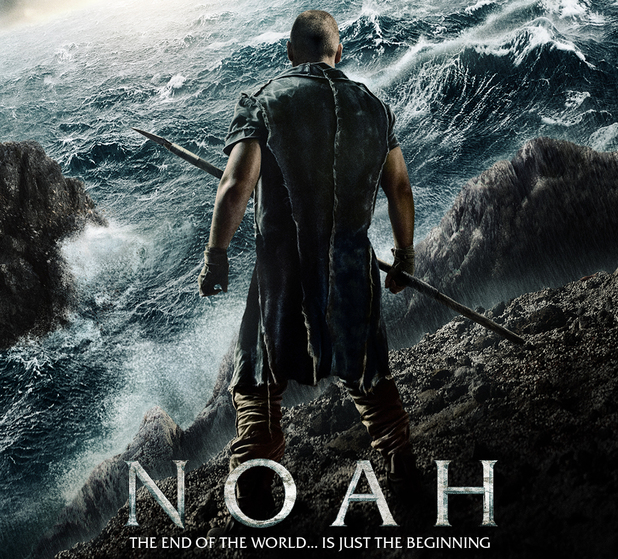
Noah


Down and Dirty: An outsider’s intriguing retelling of the biblical epic of Noah

Director: Darren Aronofsky (Black Swan, The Wrestler, Requiem for a Dream)

Big Names: Russell Crowe, Jennifer Connelly, Anthony Hopkins, Emma Watson


Different people have different problems with the film Noah, but everybody finds something they don’t agree with. It was designed that way. Director Darren Aronofsky knew it was going to be controversial when he decided to adapt a biblical story as a Non-Christian in a predominantly Christian nation - understand that before you go see this, or at the very least try to appreciate his perspective. I understand why Christians might be offended. This is one of the cornerstones of biblical faith being re-imagined by a man who does not understand the nature of a personal relationship with God. But I truly believe that Aronofsky’s take holds true to the thematic elements within the biblical version of the story. Does he take artistic liberties? Absolutely. Does he deviate from the timeline and details as presented in the Bible? No doubt. But does he show that mankind is broken, worthy of death, and redeemed only through God’s mercy? I think he does.

Aronofsky weaves a gripping account of the Ark, the flood, and God’s will through beautiful CGI and cinematography coupled with a dramatic human interpretation of the events in the book of Genesis. That’s what he does best here; he connects the human element to the spiritual story. In Christian culture, the story of Noah often becomes a mythical children’s tale with a hero who saves humanity by the grace of God; and I think that’s truly Aronofsky’s understanding of it as well. But he takes that premise and shows how the trials associated with understanding God’s will can result in tangible arguments and struggles between human beings. Does he over do the subtlety of God’s presence? It depends on whom you ask. It certainly can feel like it is Noah making all the tough calls instead of God, who feels absent and aloof through most of the film. But that’s an outsider’s take on the relationship that God has with man.

As a Christian, it’s hard to watch the relationship between Noah (a devout believer) and God trimmed down to apocalyptic visions and unanswered cries to heaven. Were those aspects of communicating with God? For sure, but it’s clear that based on a Christian understanding of faith Noah definitely had a reciprocal relationship with the Lord. That is the essence of prayer, which is largely absent in this film but also not exactly spoken to in the biblical account. Elsewhere in the Old Testament, the Bible shows conversations with the Lord taking place during a time of prayer, so it can possibly be inferred that is how Noah communicated when it says the Lord spoke to him. All of this is to say that Christians cannot expect Aronofsky to understand the delicate nature of issues like this when he has no skin in the game. I don’t take offense to it; but instead I’m working to explain where my differences lie in a considerate manner. Lambasting the ‘Hollywood scene’ and its ‘secular ways’ will further remove me from the conversation about the nature of the Bible and God’s character. Quite frankly, that is the last thing I want to do – this film has already served to start great conversations in my life. I realize this review is more of an opinion piece, but I think it’s important to talk about. I would encourage you to read the book of Genesis and see the film. Form your own thoughts that allow you to discuss these issues in a diplomatic way. Movies are a human medium for telling stories. Each story means something different to everyone. Take the time to learn about what it means to both yourself and the people around you.

Sunday, February 2, 2014

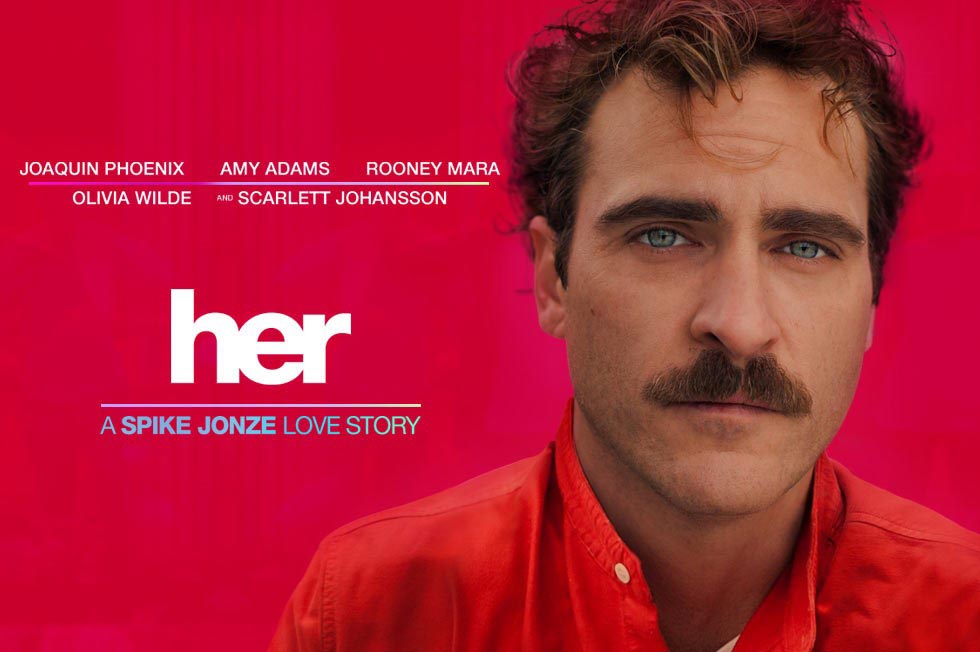
Her


Down and Dirty: An unusual but worthwhile examination of relationships

Director: Spike Jonze (Where the Wild Things Are)

Big Names: Joaquin Phoenix, Scarlett Johansson, and Amy Adams


This film is nominated for the Academy Award of Best Motion Picture of the Year for several reasons. The acting is brilliant, the near-future environment looks incredibly realistic, and the music is perfectly form fitting. But the one distinction that soars over all the others is the writing. That is also why this film brought home the Golden Globe for Best Screenplay. Spike Jonze has been working on the script for ‘Her’ over the course of the last several years. He honed it, refined it, and finally directed it this past year. You might only know him as the director of ‘Where the Wild Things Are,’ but that’s okay. That film is the perfect precursor to this one. It showcased his style as a uniquely interpretive artist who uses concise and realistic dialogue to convey a complex and emotional message. This ability has enabled Spike to create a film in ‘Her’ that challenges the audience to explore love and connection in real-life relationships.

In typical NoSpoilers! fashion, allow me to break down what you will be walking into without ruining the movie for you. This film is unlike most any other I have seen. It is intimate, awkward, emotional, funny, and ultimately an honest picture of how we interact with one another. It does not attempt to glorify love. It does not try to celebrate volatile romance. It simply shows us how we tend to be. Joaquin Phoenix plays Theodore Twombly, a writer for a company in near-future Los Angeles that sends personalized love letters. He is in the midst of a divorce when he decides to try out a new operating system on his all-in-one device. The OS is named Samantha and is an artificial intelligence counterpart played by the voice of Scarlett Johansson. What follows is a slew of emotional interactions between Theodore and his many loved ones – his ex-wife, his friends, his OS. He works on one relationship, tidily manages his friends’, and develops yet another with Samantha. Central to the film, his relationship with Samantha starts as casual niceties and conversation quickly evolves into something serious. Theodore must wrestle with the notion of engaging in an emotional connection with a nonhuman. He finds that an OS can provide a moment’s relief from the physical responsibilities of a relationship, but struggles to find all the elements of human comfort in a machine.

While the idea of computerized companionship might seem foreign to us now, it is probably not that far off in terms of technological advances in my opinion. But that isn’t the point. The point is how do our personal relationships transcend our media counterfeits and how do we truly engage with each other on a personal level? Do we seek other nonhuman outlets because we cannot deal with the realities of human relationships? People are fallible. We will get hurt inevitably. Is it so wrong to want to escape that? Or is it something we need to learn to work through? What are the costs of opting out?

Jonze asks these questions with some very witty, funny, hard-hitting dialogue. But he also hints at the answers through his characters’ growth and change.  Clamming up and shutting people out of your emotional spectrum, as Theodore does, will indeed come at a great cost - though it’s not always immediately visible. Those emotions buried deep below the skin slowly boil and bubble up, manifesting themselves in unhealthy ways. We tend to conceal our emotional issues as if that will preserve our current state of equilibrium. Instead, all this serves to do is further eliminate the vulnerability in our relationships and we are never taught how to fix the problem. This idea of the damage hidden emotion can cause becomes evident over the course of the film in much the same way. You won’t feel it there until it has crept over you and taken hold in a gutting moment of stark realization. Only then do we realize honesty would have allowed for the necessary conversation and growth in the first place.

Jonze preaches a gospel of vulnerability and honesty.  It is the emotional equipment that will set you free. And it is illustrated vividly through three things: cinematography that captures unique perspectives, a score that embodies the vibe of every scene, and a performance by Joaquin Phoenix that elicits pure catharsis.

Do not skip out on this movie because it looks weird and unusual. Challenge yourself to see a film that will force you to examine relationships in a new way and then force you to talk about what you just felt. That’s what ‘Her’ wants from you. That’s what humans want from each other.

Sunday, January 5, 2014

American Hustle


Down and Dirty: A worthy crime drama that shows you what it means to hustle

Director: David O. Russell

Big Names: Christian Bale, Amy Adams, Bradley Cooper, Jeremy Renner, and Jennifer Lawrence


Director David O. Russell decided to follow up his incredible ‘Silver Linings Playbook’ with this throwback crime drama about a federal sting operation surrounding con artists in the 1970’s. It is a worthy successor to say the least. Russell tackles a different genre than any he has previously worked in, but he navigates the new terrain masterfully.

In short, the story follows a couple of top class con artists (Christian Bale, Amy Adams) who are forced to work on behalf of the FBI (Bradley Cooper) in order to maintain their freedom. They begin targeting a local politician (Jeremy Renner) who has extensive power in the New England area.  Though we don’t spoil anything for you on this blog, you should know what you’re walking into. This movie revolves around not knowing – meaning that you’re constantly guessing who’s double crossing who, where people’s allegiance lies, and what’s in it for the parties involved. It keeps you thinking. It keeps you engaged.

This is due, in large part, to the cast Russell has assembled. Christian Bale put on a good amount of weight to portray a sleazy but lovable con artist and it paid off. He embodies this part to a T. From the comb over to the gut to the tinted shades, his physical appearance is endearingly comical. Amy Adams has an amazing scene where she voices over why her character is interested in Bale. It’s fantastic. It puts you in her character’s head while providing you with the up-and-down visuals that make Bale so spectacular. He really embraces the role. He is effortlessly smooth, smart, and sly in nearly every scene. You’ll quickly find yourself rooting for him despite his vices and broken understanding of how to be successful.

And that’s the biggest thing. His understanding of what life is about is truly broken. He has a family and a wife, albeit a crazy one played sufficiently by Jennifer Lawrence, who loves him. But he would much rather be spending his time with a woman who matches up to his own caliber of deception – a true con artist. Amy Adams plays the love interest incredibly well. Sexy, sensual, and just as smooth as Bale, they formulate a dynamic duo ready to take on the world. Unfortunately, this lifestyle simply isn’t sustainable. Illegally preying on the financially ignorant is equal parts dangerous, lucrative, and immoral and when the FBI catches up with you they don’t play around. They use you for their own gain. If there is one thing you learn from this movie it is that everyone has an angle. Everyone is in it for something. There is no shortage of skin in the game. What might surprise you though is who really represents what. Can the immoral con artists be used as tools for eliminating corruption? Is that corruption worth taking down when it actually helps the greater good? Who decides what defines the greater good? What happens when the lines get blurred?

This movie tries to answer those questions while also taking you straight back to the 1970’s. As a 90’s baby, I simply don’t know what it was like back then. Thanks to this film I now have some idea. The impeccable soundtrack and the outrageous outfits (Bradley Cooper jerry curl included) truly set the scene for the audience. As a reference point, my parents left the theatre feeling absolutely nostalgic and giddy about the representation of the 70’s within the film, even singing some of the songs they had just heard for the first time in a few decades.

As far as crime dramas go, this ranks up there with the best of them. It feels like The Sting or L.A Confidential for the next generation (check both of those out if you haven’t seen them). Overall though, there have been too many other good films this year for me to put this in award contention, but I wouldn’t be shocked if Bale got a nomination for his role. His versatility as an actor cannot be understated. Russell chose him for a reason. If this genre tickles your fancy or you appreciate a really terrific ensemble of actors, I would highly recommend American Hustle. Don’t let the critics con you, this film won’t disappoint.

Wednesday, November 27, 2013

Twelve Years A Slave


Down 'N Dirty: A tragic, captivating, gut-wrenching, and world-class film about slavery.

Big Names: Every single person in the film.


I'd like to start this out with a WARNING: This movie is absolutely not for the faint of heart. There are multiple scenes of gratuitous violence. These violent scenes are usually 1-part disturbing because of the realistic art, make-up, and animations; 2-parts disturbing because of the psychological damage that each character endures from being mercilessly abused by another person (treated as an "animal," if you look at it from their perspective) or mercilessly abusing others; and 3-parts disturbing because this film has been so excellently crafted that each member of the audience is forced into the view-point of enslavement. I say forced because that's what it is--you have no option but to understand why each character behaves as they do, and it is often times sickening. 

There is also a lot of hang time, or what some might call 'needlessly long shots,' for each scene in this film. This choice, made by a director who clearly knows what they are doing, allows the audience to really get to think about what they are witnessing; the audience is there before the atrocities happen and must stay there afterwards to live through them, resulting in beautiful cinematography that is both purposeful and artistic. The sun is only shown behind a barricade of tree branches, which is a symbol of captivity from the light and freedom our main character has already known. Certain songs last longer than others because they carry more weight with what is visually happening on the screen, or are perhaps cut short/mid frame to heighten a drastic shift in mood. There are close ups to emphasize certain details when needed and long-range shots used to put the smaller events into the larger perspectives when needed. Again, each of the stylistic techniques used are much more than "trying to be artsy," they all convey meaning and contribute to the audience's subconscious reactions and emotions throughout the film. 

After beginning this review with words that might deter people away from viewing it, I now challenge all of you to see this film. I have never seen a slave-related anything that was so powerful. This is the best movie I've seen in years. It is the second time in my entire life that the final credits started rolling and I could not get out of my seat; I just sat there and thought about everything I had just witnessed--me and my buddy cannot stop talking about it and it's been three days since we saw it now.

More than anything else, this is a very important movie to see. And, honestly, it is important for white people to see. I think this movie does a good job at helping anybody of any color understand why racial tensions are still high... it shows how this sort of thing gets passed down from generation to generation to generation and cannot be forgotten over time because it must not be forgotten over time. Slavery is not something that's worth pretending never happened. This was our country's Holocaust, possibly even worse. Everyone should see this film and whoever does so will be a better human being for it. Even if you don't think about it ever again--if it get's lost in the back of your brain until the day you die--this movie will still be in the back of your brain because it will have an effect on you; the sort of effect that will make you want to hold the door open for someone else or start a conversation the next time you're in an elevator. It unifies man-kind; through these despicable actions of hatred, the audience sees how similar we all are.

On top of all that, this movie made me feel like a dumb-ass for enjoying Tarantino's "Django Unchained" that came out last year. This movie also made Tarantino look like a five year old with too much money. "Twelve Years A Slave" will force you to remember that slavery was not cool, or funny, or a great time, or something that people need to lighten up about. Slavery was absolutely horrible. It is not an action comedy. 

I could write about this movie all night, but I'd like to finish this post by saying this movie is absolutely fantastic despite it's content matter. Slavery is a subject that invokes a multitude of different emotions in each and every one of us, and any subject matter that can do that makes for a great background in any dramatic narrative. Every film-related aspect of "Twelve Years A Slave" was top-notch. The acting was phenomenal, the script was phenomenal, the camerawork was phenomenal, and that all means that the directing was too. There will be many Oscar nods in this movie's direction in the near future.

Brace yourselves before you leave home, and then go see this movie. 

Tuesday, November 26, 2013

The Hunger Games: Catching Fire

Down and Dirty: Must See Sequel

Director: Francis Lawrence (I Am Legend, Constantine, Water for Elephants)
Big Names: Jennifer Lawrence, Josh Hutcherson, Liam Hemsworth, Philip Seymour Hoffman, Woody Harrelson
What are the best sequels you can think of off the top of your head? A few come to mind for me: LOTR: The Two Towers, Indiana Jones and the Temple of Doom, Star Wars: The Empire Strikes Back, The Dark Knight. All of those films succeeded in carrying on the essence of their franchise while changing the feel completely. Many take on a more serious tone. The foundation has been laid, now everything gets real. Catching Fire aligns with this trend and belongs on that list without a single doubt in my mind. It is the bridge between the casual child slaughtering ritual and the reality of class warfare.
The premise of this series is a subversive one. Collins wrote the novels hoping to showcase two ideas: we, as a society, have become extraordinarily numb to brutality and violence; and we knowingly embrace an incredibly damaging caste system. This first idea is illustrated well in the first film. The visceral deaths in the games are not glorified, nor are they dwelled on, they simply occur. It catches the audience off guard how seemingly banal it all feels. This notion is shown in the second film, but not nearly as much. Instead, Catching Fire serves as the walkway between the two major ideas that Collins perpetuates. As Katniss Everdeen travels, disillusioned districts start vocalizing their concerns as class warfare rears its ugly head. The games still take place, but only as a necessary transition to the real war that lies on the horizon.
From a plot standpoint, it is a rather simple track. It mirrors the first film, while tracking the political atmosphere in the greater state of Panem. But it is the characters that make this second entry so fantastic. My brother made a rather perceptive insight when he explained to me that what made the first book so much better than the movie is that it allows you inside Katniss’ head. No matter how good of an actress Jennifer Lawrence is, you lose out on those mental notes in the film. However, in Catching Fire, Katniss spends much more time interacting with people than she did previously. We don’t need the mental notes because she is so impulsive and vocal that she's constantly expressing these things outwardly. All we need to see are the key moments of dialogue that best illustrate such notions, the killing we’ve grown numb to, and the lack of emotional commitment that fuels the fire of the love triangle. J-Law knows this and runs with it. She is utterly captivating as the reluctant/ignorant savior of the working class, caught between two young men who care for her very dearly. She owns the role. Lawrence’s recent success as a film star has undoubtedly given her the confidence to carry the weight of the franchise and all of Panem. I believe her when she can’t decide who to trust, who to love, or who to kill. We’ve all been there right?
But in all seriousness, the cast of characters really carries the story. Why should you care about the fictional working class people of fantasy-land District 12? For two reasons. One, it tends to parallel our current nation state and hypothesizes about the very real dangers of class distinction. Two, you know the characters (Katniss, Prim, Gale, Peeta, Haymitch) who call it home; and each of the actors representing those characters make you care. They sell it. The melodrama doesn’t even feel like melodrama. It feels genuine. This is the kind of sequel that gets you so invested in each of the characters that when it ends you yell, “What the hell! We need more!” Director Francis Lawrence knows this. He draws you in with enticing action sequences and touching moments and then leaves you salivating. His previous work is criminally underrated. I thought I was going to hate Water for Elephants. This was another film that had melodrama written all over it with the guy from Twilight; and yet, it was a captivating, emotional tale of love and what we will do on its behalf. I Am Legend had some of the most visually exciting CGI I’d ever seen. Francis Lawrence made sure to showcase Will Smith killing zombies and made it look extra badass. In my opinion, both of those films gave him very different elements that he then blended together to develop the perfect cinematic tone for Catching Fire.
This is one of those rare sequels that surpass the first film. Go see it.

Sunday, November 17, 2013

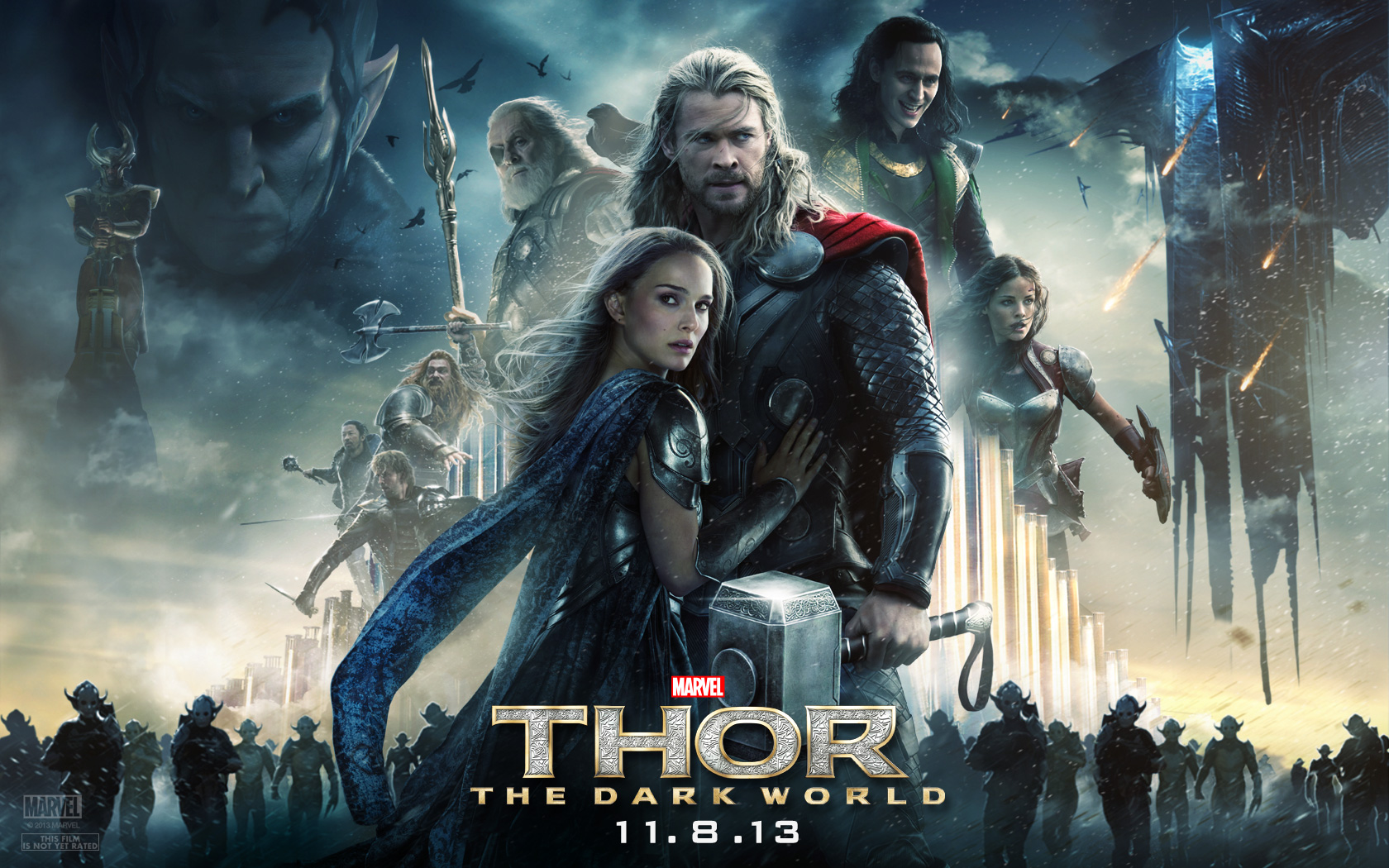
Thor: The Dark World


Also known as Thor 2: The Second Thor Movie


Down and Dirty: Solid action movie. If you enjoy fantasy/sci-fi, you’ll enjoy this.

Director: Alan Taylor

Big Names: Chris Hemsworth, Natalie Portman, Tom Hiddleston, Anthony Hopkins


Do you remember when CGI started to look good a handful of years ago? As in truly believable, to the point where you couldn’t tell what was green screen and what wasn’t? Well we’ve reached that point…and totally surpassed it. Thor: The Dark World is an exploration in fictional storytelling. Ten years ago, this film simply would not have been able to be made. The setting of the movie, the fantastical world of Asgard, feels eerily real thanks to the high quality production. Almost like it’s a possible exotic vacation destination you are seeing an advert for. The cinematography is gorgeous. Crisp colors, seamless panoramic shots, and versatile environments pop up often with extraordinary ease. Director Alan Taylor has captured the most important part of the Thor franchise: the grandeur of the setting. Without perfecting this aspect, the film would probably break down the second the characters leave Earth. Thankfully this doesn’t happen. In fact, the entire time the characters were on Earth I was wondering when we were going to get back to the action on the fascinating and beautiful outer realms of the universe. This film is a prime example of how CGI technology can bring imagination to life. See for yourself, the sprawling wonder of Asgard is pictured below.


Apart from being a beautiful movie though, The Dark World is extremely entertaining. Do not be turned off by the typical high fantasy introduction surrounding 'dark elves' and magic stones. These are merely the catalysts for all the cool action that is about to go down. High-strung battle sequences are bookended by quick, meaningful plot devices. The characters are interesting, funny, and lovable (except the evil elf lord, no one could love him). I expected the Norse dialogue to be longwinded with distracting accents, but honestly it is witty, concise, and occasionally hilarious. As Thor, Chris Hemsworth literally throws his weight around on screen and it is delightful to watch him break stuff. Natalie Portman is just your typical American chick, working on her thesis, dealing with interns, and getting emotionally invested with a Norse god. Kat Dennings, Portman’s assistant, provides poignant comic relief as she observes the unusual relationship. And she does it in such a way that it becomes clear the film doesn’t take itself too seriously. I think these comedic moments help bridge the gap for viewers who aren’t diehard fantasy fans, as they can simply appreciate a good laugh alongside the comic book fanboys.

On paper, this film really shouldn’t be that good. It seems like a lot of recycled material from both the fantasy and science fiction genres. You won’t find anything terribly new here from a story standpoint, but the film knows what it is and proceeds accordingly.  It’s just a fun ride. Despite being a fantasy/ science fiction crossover with lots of cliché artifacts and elvish lore, it still feels original. Nothing feels unnecessary or overused and I found myself super entertained throughout. Alan Taylor is known for his directorial work on TV, but he made quite a splash here with his first big-budget action film. If you want to go enjoy a fun action movie with a lot of fantasy elements, this is for you.

P.S. Stick around after the credits for an incredibly weird scene featuring Benicio Del Toro with blonde hair.